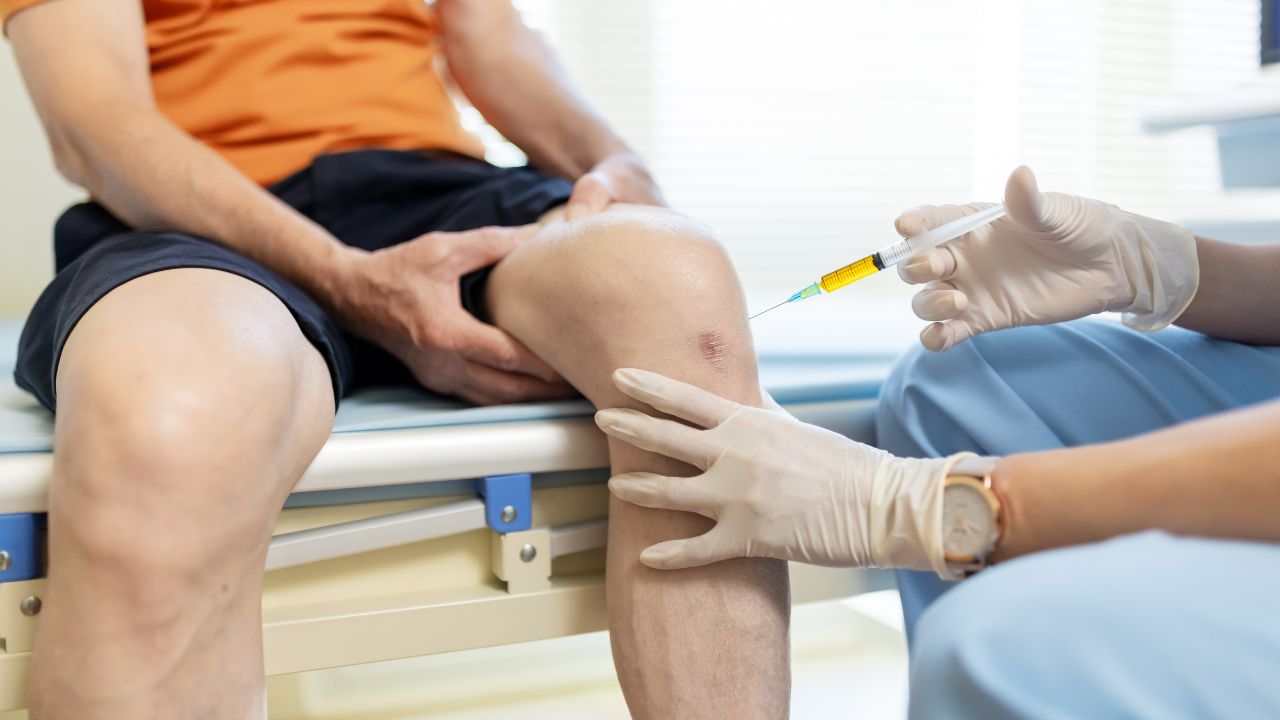
PRP for Knee Pain & Osteoarthritis
Written and medically reviewed by David Nazarian, MD — Board Certified in Internal Medicine and Medical Director of PRP Treatment Beverly Hills.
PRP (platelet-rich plasma) is a nonsurgical option I consider for selected patients with knee pain, particularly some patients with mild-to-moderate osteoarthritis. In my practice, I first look at the diagnosis, imaging, degree of structural disease, symptoms, prior treatment, and whether the goal is realistic improvement in pain and function rather than a promise to regrow cartilage.
PRP Treatment Beverly Hills offers physician-supervised PRP knee injections for osteoarthritis and selected joint conditions for patients in Beverly Hills and the greater Los Angeles area. Patients commonly want to know whether PRP is appropriate for osteoarthritis, how it compares with corticosteroid or hyaluronic-acid injections, what recovery is like, how many injections may be considered, and what treatment costs. Those questions are addressed during evaluation before an injection plan is recommended.
Knee osteoarthritis (OA) is very common, and the lifetime risk is estimated at about 45%. OA is a degenerative joint disease that affects the cartilage, bone and other tissues of the joint. As the cartilage wears down, the joint becomes painful and stiff, and mobility is reduced.
PRP is a concentrate of platelets and growth factors made from your own blood. Research suggests that PRP injections may reduce pain and improve function in people with mild to moderate knee osteoarthritis. PRP is one of several options, alongside exercise, weight management, physical therapy and other injections.
Dr. Nazarian’s Clinical Perspective on PRP for Knee Pain
Many patients come to my office with knee pain already convinced that they need a PRP injection. My first question, however, is not whether PRP should be injected. It is: what is actually causing the knee pain?
Knee pain is a symptom, not a diagnosis. I examine the knee carefully and review any imaging the patient has already had. If the diagnosis is still unclear, I may recommend an X-ray or MRI depending on the symptoms, physical examination, history, and the type of injury I suspect.
Patients frequently ask about PRP for knee osteoarthritis.
Knee PRP Treatment Decision Framework
| Finding | How it affects the decision |
|---|
| Mild-to-moderate osteoarthritis | PRP may be considered for selected patients with persistent pain or reduced function. |
| Advanced or end-stage arthritis | Response may be less predictable, and other treatments may be more appropriate. |
| Mechanical locking, instability or major meniscal pathology | Further orthopedic evaluation may be more important than an injection alone. |
| Unclear diagnosis | Diagnosis and imaging should be clarified before deciding on PRP. |
My clinical approach: I use the diagnosis, imaging, degree of structural disease, symptoms, prior treatment and realistic goals to decide whether PRP is reasonable. PRP should not be presented as a way to regrow worn-away cartilage. — David Nazarian, MD
Physician Answers: PRP for Knee Osteoarthritis
Does PRP work for knee osteoarthritis?
PRP can improve pain and function in some patients with mild-to-moderate knee osteoarthritis, but results vary and it should not be presented as a way to regrow cartilage or reverse advanced arthritis.
Who is most likely to benefit?
I am more likely to consider PRP when the diagnosis is clear, symptoms remain meaningful despite appropriate conservative care, and imaging does not show end-stage structural disease. Patient age, activity level, prior treatment, alignment, meniscal pathology, and overall health can influence the decision.
When would I recommend something else?
Severe joint-space loss, major mechanical symptoms, instability, acute fracture, infection, or another diagnosis may make a different treatment more appropriate.
Research suggests PRP can improve pain and function in some patients with mild to moderate osteoarthritis, but I am careful not to present it as a way to regrow worn-away cartilage or reverse advanced structural arthritis. In patients with severe joint damage, the underlying mechanical problem may limit how much an injection can accomplish.
I also evaluate PRP or PRF differently when the problem involves a more localized soft-tissue injury, such as selected partial tendon injuries, patellar tendinopathy, some ligament injuries, collateral ligament injuries, or certain meniscal injuries. The severity matters. A partial injury may sometimes be treated conservatively, while a major structural tear may require orthopedic or surgical evaluation.
For me, the diagnosis matters more than the injection. PRP and PRF are tools, not substitutes for identifying the structure causing the patient’s symptoms and determining whether biologic treatment has a reasonable role in that specific case.